Jun 052012
 

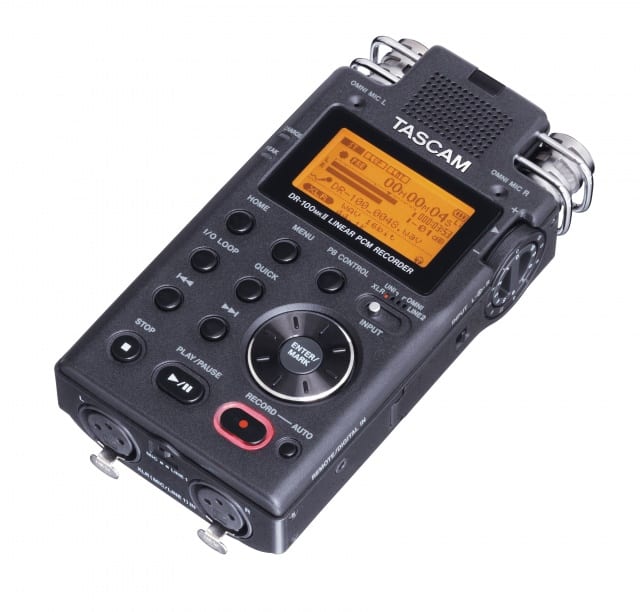
Small, portable audio recorders have become much more popular since the start of the s0-called DSLR revolution.  Of course they have always been around in the professional industry but when people began filming with DSLRs they quickly realized that the sound on those cameras was simply awful.  A solution was needed and a great many people jumped on the Zoom H4N as that solution.  At the time when the 5D MK2 was released there weren’t a lot of options at a price point that made sense to someone who is only shooting with a camera worth a few thousand dollars.  In 2010 though, Tascam launched the DR-100 and at the end of 2011 they followed this with the updated DR-100 MKII which has a price point similar to the Zoom.  Of course now we also have many even cheaper solutions than both of these so I want to evaluate both the DR100MK2 and the H4N and find out if we really need them, and if so, which one would I choose for my audio kit.  B&H Photo kindly provided me with one of these newer Tascam recorders so that I could test it out and see what I thought of it.

Specs

Tascam Dr100 MKII

  • 4 Built-In Microphones
  • Dual XLR Inputs with 48V Phantom Power
  • 24-bit/96kHz WAV and MP3 Recording
  • Record to SD and SD-HC Cards
  • Line Level I/O
  • S/PDIF Input
  • Variable Speed Playback (-50% to +16%)
  • Built-in Speaker
  • Rugged Aluminum Casing
  • AC or Battery Power

Zoom H4N

  • True X/Y Stereo Mics
  • Selectable Recording Patterns
  • Records up to 24-bit/96kHz
  • Records to SD/SDHC
  • XLR/TRS Combo Inputs
  • Built-In Speaker
  • Backlit LCD Display
  • Uses AA Batteries
  • Hard case Included

Continue reading »

Jan 222012
 

Rode Microphones has just announced details of two new DSLR friendly microphones.  The Stereo Videomic Pro continues their form factor and feature redesign that we saw last year in the Videomic Pro but implements it on the old Stero Videomic.  The second microphone is even more interesting though as it is the first microphone in the world to combine a shotgun mic with a built in recorder and basic mixing capabilities as well as audio monitoring.  Read on for more details….


Continue reading »

Jan 032012
 

Getting around the deficient audio in DSLR video production is always a tricky problem for one reason or another.  There are several ways to do it , depending on which camera you are using but it also depends on whether you want to shoot separate audio tracks and sync in post using Plural Eyes , or whether you want to record straight into the video track on camera.  The latter route will never be as high quality but sometimes you just don’t have time for the extra step in post of syncing and managing the audio files.  Of course the first step to better audio is just to use better microphones and those all have XLR outputs on them so you need a way of connecting XLR’s to your camera.  A popular solution has been the ZOOM H4N and it’s been good at that price point though it was never really designed for this use.  The H4N is several years old now, predating the so-called DSLR revolution in fact, and was designed to record music, both live and at line level through 1/4″ plugs from guitars.  One of the problems with it is the sensitivity of the 1/4″ line in signal is not at a typical line in level so inline pads are required as well as xlr-1/4″ TRS conversion of you want to record a line level signal and bypass the pre amps in the H4N.  For me, no line level XLR input on the H4N is a big shortcoming for the flexibility of it’s usage.

The Tascam DR-100 was also used by quite a few people instead of the H4N but the original version also lacked the line level input that I would like to see.  Tascam has just recently started to ship two new recorders though that BOTH feature mic and line level XLR inputs.  The updated MKII version of the DR-100 and the brand new DR-40 which now takes over from the H4N as the most affordable XLR recorder on the market at around $200.  Let’s take a look at their main features:

Continue reading »

Jul 132011
 

Samson’s audio products have cropped up a few times on my site and for good reason, they represent good value for money.  I reviewed the Zoom H1 recently and found the sound quality to be very good but the $99 price tag left the build quality a little to be desired.  The Zoom H4N has been mentioned several times as well and has become a somewhat ubiquitous accessory for DSLR budget film making with it’s 4 channel control.  Samson have today updated their H2 model to a new H2N which looks to be a great middle lineup addition.  Priced at $199 and set to go on sale in September it seems as though this would stand up to a little more wear ad tear than the budget H1.  The H2N has a confusing array of 5 on-board microphones and many modes to implement them.  Probably best to watch the video below to understand a little more!

Jun 062011
 

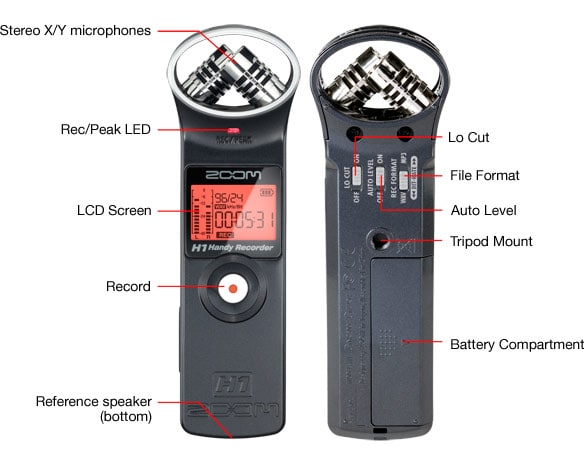
The Zoom H1 has been around for a year or so now and I’ve mentioned it before on this site but only now had a good reason to pick one up for myself.  At the time of writing this I’m packing my gear to head to France to shoot the 24 Heures Du Mans, arguably the worlds greatest motor race.  I decided that the sound of the cars on the track would be interesting to capture for some multimedia content after the event and the H1 looks to be a reasonable solution.  Ever since DSLRs began to record video, photographers have been looking for ways to expand their trade and offer more to their digital clients.  Whether it’s purely video or a melange of video, audio and photos from an event or news assignment, multimedia is here to stay on the internet or in digital magazines on platforms such as the iPad.  The only problem is that the on-board microphones of the DSLRs are….. well they are crap aren’t they!  So you need another solution and there’s two ways to do it.  Either you run an external mic into the camera and record the audio track alongside the video, or you use a separate reorder and sync the sound with the video in post production using software such as Plural Eyes.  The first option has speed and ease on it’s side whilst the second has audio fidelity and flexibility on it’s side.  A separate recorder can be placed anywhere, or simply used to record ambient noise.

Continue reading »

Jun 032010
 

5dH4If you shoot video with a Canon DSLR you already know the audio sucks.  Or even if you don’t, maybe you have read my guide to audio and microphones for these cameras ! Recording your audio separately is without a doubt the way to get the highest quality audio track but it adds a couple of daunting extra steps to your production. Firstly the simple process of making sure you record the audio and not just the video while you are shooting, 2 record buttons to press!  And secondly syncing that audio to your video track in post-production.  I guess you could also add in an extra middle process in there of keeping all the audio files organized in a way that you can relate them to the video clips.  This all sounds pretty time consuming but for the last year or so lots of people have been singing the praises of a piece of software called PluralEyes from Singular Software.  Available as a plug-in for Final Cut, Premiere and Vegas, it takes your the audio track that is associated with your video track and automatically analyzes the waveform to match it up with your second separately recorded audio track.  Great if you have one of those 3 editing programs, but consumer video users were left out in the cold. Not any more though…… DualEyes is a new program in beta testing from Singular.  And rather than being a plug-in, it is now a totally separate program meaning that anyone can use it all the way from iMovie makers to pros already using Final Cut , but wanting a more streamlined workflow for audio syncing.  Take a look at the demo video that they posted on their website, it really looks very easy and would be perfect to use with the new Zoom H1 audio recorder or the H4N.

Jun 012010
 

H1_side-hero-webSamson Tech stumbled onto something great with the ubiquitous Zoom H4N audio recorder.  When the DSLR video craze kicked off, people quickly realized that whilst the video was stunning to look at, the on-board audio sucked.  All professional films use separate audio recorders though, and the HDSLR crowd quickly fell in love with the full featured Zoom H4N.  Built in stereo mics and 2 XLR inputs meant 4 track recording was possible in a device that was only $300.  Samson was in the right place at the right time with the right price, the H4N was and still is everywhere.  But many of the features of the H4N were unnecessary to the “run and gun” photo journalist who just want to record some background audio for a multimedia piece, or just use one extra microphone like a shotgun to get slightly more directional pickup.  Well the folks at Samson heard your calls and today announced their first piece of audio gear that was actually designed with DSLRs in mind.  The Zoom H1.  Continue reading »

Related Posts Plugin for WordPress, Blogger...